Catit water fountains: the short verdict
Catit is a sensible starting point for an indoor-cat owner who wants to compare documented fountain designs rather than accept a universal “best” pick. The original Catit Flower Fountain has a clear, model-specific proposition: a compact 3 L reservoir, three selectable water-flow styles and a design that continuously circulates water through a Triple Action Filter before returning it to the drinking surface.
That combination may suit a household looking for adjustable flow and filtered water in a relatively compact format. It is not evidence that every Catit fountain has the same capacity, material, noise level, cleaning routine or ongoing filter cost. Catit’s current help pages list several Flower and PIXI variants, including stainless-steel, ceramic, smart and standard PIXI models.
The practical verdict is conditional: shortlist Catit if the documented Flower Fountain features match your cat’s preferences and your routine, then verify the exact model’s materials, cleaning instructions, indicators, replacement-filter availability and current price before buying. This is product information, not hands-on testing or veterinary advice.
For a wider decision framework, use the site’s cat water fountain buying guide alongside the official documentation for the specific model you are considering.
What Catit’s drinking-fountain range includes
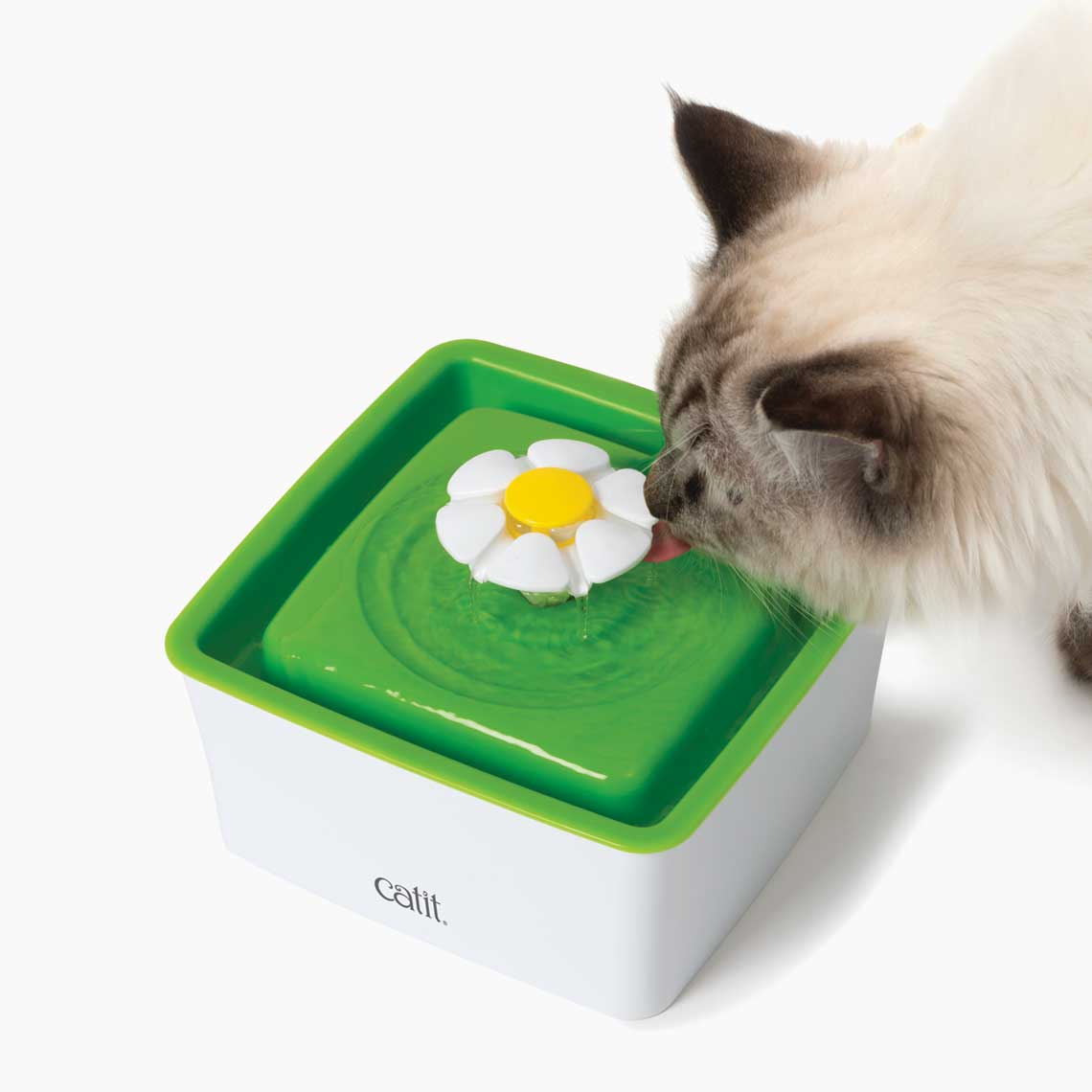 Catit’s drinking-fountain family is broader than the original green Flower Fountain. Its official fountain help page lists the Catit Flower Fountain, Mini Flower Fountain, PIXI Stainless Steel UV-C Drinking Fountain, PIXI Ceramic Fountain, PIXI Smart Fountain, PIXI Fountain and a Stainless Steel Drinking Fountain. That is useful context, but it also creates an easy comparison trap: a feature described for one product should not be treated as a feature of the whole range.
In particular, the detailed documentation supplied for this review concerns the original Flower Fountain. It identifies a 3 L capacity, BPA-free plastic construction, a water-level window, three flow settings and Triple Action filtration. The range listing, by contrast, establishes that Catit sells distinct PIXI and Flower variants; it does not establish a shared specification sheet for all of them.
Start any comparison by naming the exact product, not just “a Catit fountain”. Then separate the questions that belong to that product from the questions that belong to your household:
- Capacity: how much water does the specific model hold?
- Material: is the exact version plastic, ceramic or stainless steel?
- Filtration: which filter does it use, and what do replacements currently cost?
- Routine: what access does the model provide for cleaning, refilling and checking water level?
- Ownership: what parts and support information are available for that exact fountain?
The site’s guide to choosing a fountain by household size can help put capacity alongside the number of cats and the frequency with which you are comfortable refilling and cleaning.
Documented strengths of the Catit Flower Fountain
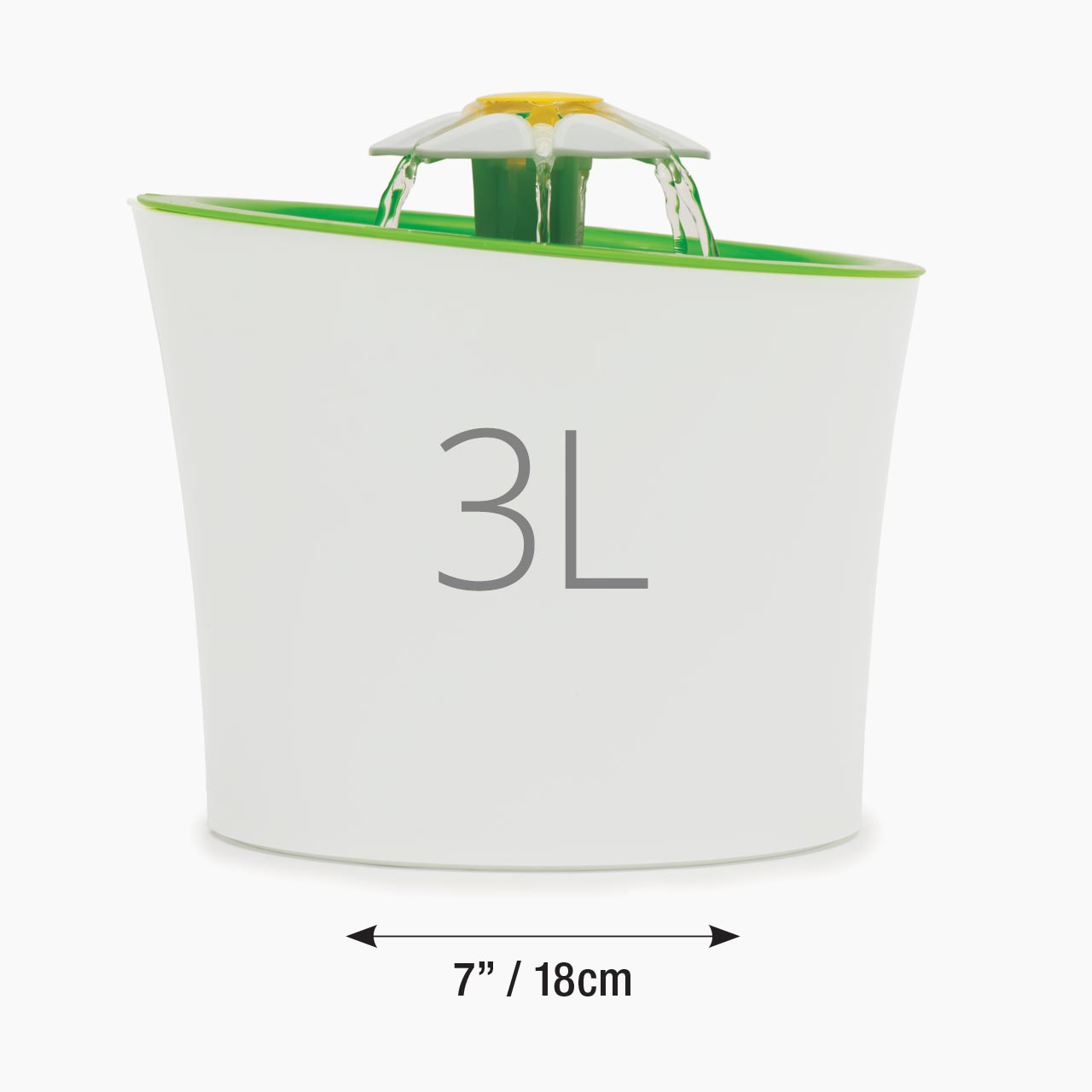 The original Catit Flower Fountain’s strongest documented advantage is choice of water presentation. Catit says it can be set up for a gentle water flow, a bubbling top or calm streams. For a buyer whose cat appears particular about how water is presented, that is a more useful feature than a single fixed flow. It does not guarantee that an individual cat will prefer, use or drink more from any setting, but it gives the owner three options to try within one documented model.
Capacity is another straightforward strength. Catit states that this compact fountain holds 3 L (100 fl oz). The unit also has a water-level window, intended to make it easier to see when a refill is due. A 3 L reservoir may be appealing where countertop space matters, provided the owner is still willing to follow the manufacturer’s current cleaning and refill guidance.
Catit describes the original Flower Fountain as made from BPA-free plastics. That is a specification for this model, not a reason to assume that a PIXI Ceramic or PIXI Stainless Steel UV-C model uses the same material. Material preference is personal as well as practical, so compare the exact version rather than treating the Flower Fountain as a proxy for the range.
The Flower Fountain is also designed so that water returned to the drinking surface has passed through Catit’s Triple Action Filter. In the manufacturer’s description, water flows back into the reservoir and is filtered below the top cover before the pump returns it to the surface. Catit says the filter softens water and removes odours, impurities and hair. That explains the intended filtration design; it should not be expanded into a health, hydration or medical claim.
Taken together, these features make the Flower Fountain a credible option for buyers who value an adjustable flow, visible refill cue and filtered-water setup. They do not, on their own, prove quiet operation, effortless cleaning, long-term durability or low lifetime cost.
Limits and checks before you buy
The supplied documentation leaves several ownership questions open, and those gaps matter more than a familiar shape or brand name. Before buying, check the current page, manual and retailer information for the precise model you intend to order.
First, confirm cleaning access and the recommended maintenance steps. A fountain can have a useful capacity and filtration system while still demanding a routine that does not suit your household. The Flower Fountain documentation explains its flow and filtration concept, but the supplied evidence is not enough to rank its cleaning effort against another fountain or to call it easy to clean.
Second, check noise-related information for the exact model. Flow pattern, pump design, water level, placement and surrounding surfaces can all affect what an owner notices at home. The evidence provided here does not establish a noise rating or a quietness claim for the Flower Fountain or for any PIXI variant.
Third, verify indicator behaviour and the parts ecosystem. The Flower Fountain has a water-level window, but a window is not the same thing as a smart alert or status indicator. Different PIXI variants may have different features, and the range listing alone is not enough to assume that a ceramic, stainless-steel, smart or standard PIXI product behaves the same way.
Finally, price the recurring items before treating the fountain as inexpensive to own. Confirm the correct replacement filter, current pack price, availability from a reliable seller and any replacement-part support. Filter type, availability and cost can materially change the ownership decision, but none should be inferred from the word “Catit” alone.
Use the site’s fountain cleaning and maintenance checklist to record those answers before checkout.
Alternatives and comparison criteria
Compare Catit with alternatives when another model may fit your material preference, maintenance routine or parts budget better. A brand’s familiar look is not a substitute for checking the exact reservoir, filter and cleaning arrangement.
An independent editorial review of cat fountains notes that a preference for running water is common among cats and helps explain why fountains appeal to some shoppers. That is useful background for considering a fountain at all. It is not proof that every cat will prefer moving water or that a particular fountain will increase an individual cat’s water intake.
Use the same questions for every candidate:
- Capacity and footprint: Does the stated reservoir size fit your refill routine and available space?
- Materials: Do you prefer the material used in the exact model, and is it clearly documented?
- Flow options: Does the design offer the type of water presentation you want to try, without assuming your cat will respond in a particular way?
- Filtration consumables: Which filter is required, how often does the manufacturer currently recommend replacing it, and what do compatible replacements cost?
- Cleaning access: Can you comfortably reach the reservoir, top pieces and other components according to the current instructions?
- Noise-relevant design: Is there credible, model-specific information about pump, flow and operating conditions, rather than a broad “quiet” label?
- Parts support: Are filters and relevant replacement parts available from manufacturer-supported or reliable retail sources?
This framework may point you back to Catit, especially if the Flower Fountain’s 3 L capacity and three flow settings are a close fit. It may also reveal that a different Catit variant or a competing fountain better matches your priorities. Check live manufacturer and retailer support information before deciding, because prices, stock and support availability can change.
The site’s cat water fountain comparison hub and guide to fountain filters and recurring costs are useful places to organise that comparison.
How to choose the right Catit fountain
Make the choice in a sequence that keeps range-level marketing separate from model-level facts.
- Identify the exact product. Decide whether you are considering the original Flower Fountain, a Mini Flower Fountain, a PIXI version or another listed Catit fountain. Do not compare a generic “Catit PIXI” description with Flower Fountain specifications.
- Match capacity and material. For the original Flower Fountain, Catit documents a 3 L capacity and BPA-free plastic construction. Check the current specifications for any other variant rather than carrying those details across.
- Consider flow and filtration. If adjustable presentation matters, the original Flower Fountain offers gentle flow, bubbling top and calm streams. Confirm the filter type and replacement information for the exact product.
- Check the maintenance reality. Read the current cleaning instructions, inspect the parts layout in official material where available and decide whether the required routine fits your schedule.
- Price ownership, not just purchase. Check current filter packs, replacement-part support and retailer availability before you set a budget.
- Keep the boundary clear. This is a product-selection process, not veterinary guidance. If you have concerns about your cat’s drinking or health, seek advice from an appropriate veterinary professional.
A specific Catit fountain can be a good fit when its documented capacity, material, flow and maintenance requirements align with your home—and when you have verified the model-specific ownership details that the range listing cannot answer. Use the site’s cat fountain pre-purchase checklist to keep those checks together.
Frequently Asked Questions
Is the Catit Flower Fountain suitable for cats that prefer different water-flow styles?
The original Catit Flower Fountain is documented with three setups: a gentle water flow, a bubbling top and calm streams. That gives an owner options to try. It does not prove that a particular cat will prefer one of those styles or drink more from the fountain.
How much water does the original Catit Flower Fountain hold?
Catit states that the original Flower Fountain has a 3 L (100 fl oz) water capacity. It also has a water-level window so the owner can check when a refill is due. Confirm the capacity separately for Mini Flower, PIXI and other Catit variants.
Are all Catit PIXI fountains made from the same material?
No conclusion should be drawn from the supplied range listing. It separately names PIXI Stainless Steel UV-C, PIXI Ceramic, PIXI Smart and PIXI Fountain products, which indicates distinct variants. Check the official specification for the exact PIXI model before buying.
What should I check before budgeting for Catit replacement filters?
Identify the exact fountain first, then confirm the required filter type, current pack price, availability and manufacturer or retailer parts support. The original Flower Fountain documentation describes a Triple Action Filter, but that should not be assumed to define the filters, price or availability for every Catit fountain.
For more model-neutral answers, see the site’s full cat fountain FAQ hub.
Sources
Related reading
- Best cat water fountains: an evidence-led comparison of cleaning, capacity, materials and filter upkeep
- Catit vs PETLIBRO cat water fountains: flow, cleaning, filters and smart features compared
- PETLIBRO Dockstream review: smart tracking, cordless design, cleaning and ongoing costs
- Stainless steel vs plastic vs ceramic cat water fountains: cleaning, weight and daily-use trade-offs
Editorial information: About our editorial team · Read our editorial policy · Read our affiliate disclosure.