A cat water fountain is easier to live with when its surface, removable parts and refill routine suit your household. Stainless steel, plastic and ceramic describe only one part of the product: capacity, filter system, pump access and availability of replacement parts can have just as much effect on day-to-day ownership.
How to Compare Fountain Surfaces Fairly
Start with the tasks you will repeat: carrying the fountain to the sink, refilling it, taking it apart, cleaning the water-contact parts and replacing consumables. Then read the instructions for the exact model rather than relying on the material name alone.
Useful questions include:
- Which parts are explicitly dishwasher safe?
- Can the top, filter and pump be removed without treating the whole fountain as one piece?
- Is the stated capacity realistic for your household’s refill rhythm?
- Does the maker list compatible filters and a replacement pump?
- Will the fountain’s size, placement and handling suit the person who will clean it?
Manufacturer listings show why this distinction matters. Catit specifies that the stainless-steel top of its PIXI model is dishwasher safe, while Pioneer Pet lists both replacement filters and a replacement pump for its stainless-steel Raindrop model. Those are model-level details, not guarantees for every fountain made from the same surface.
The Daily-Use Trade-Offs at a Glance
A practical comparison is less about declaring one surface “best” and more about finding the least awkward routine for you.
| What to compare | Stainless steel | Plastic | Ceramic |
|---|---|---|---|
| Cleaning instructions | Check whether the listed steel component, rather than every component, is dishwasher safe. | Check the exact model’s cleaning directions and the number of removable parts. | Check the manufacturer’s cleaning directions for the specific fountain. |
| Handling | Review the full product’s size and construction, not only the surface material. | Review shape, footprint and access to the reservoir and pump. | Consider where it will sit and how you will move it for cleaning. |
| Consumables | Confirm the filter and pump part numbers for the model. | Confirm current filter and pump availability before purchase. | Confirm that filter and pump support match the specific model. |
| Refill routine | Compare the stated capacity with your household’s needs. | Capacity varies by model, not by plastic as a category. | Capacity varies by model, not by ceramic as a category. |
For example, Pioneer Pet lists its Raindrop stainless-steel fountain at 60 oz and identifies compatible replacement filters and pump. PetSafe’s current fountain range spans multiple capacities and materials, including stainless-steel and ceramic options. Capacity therefore deserves its own comparison: it can change how often you refill, regardless of the bowl surface.
Stainless Steel: Practical Strengths and Checks
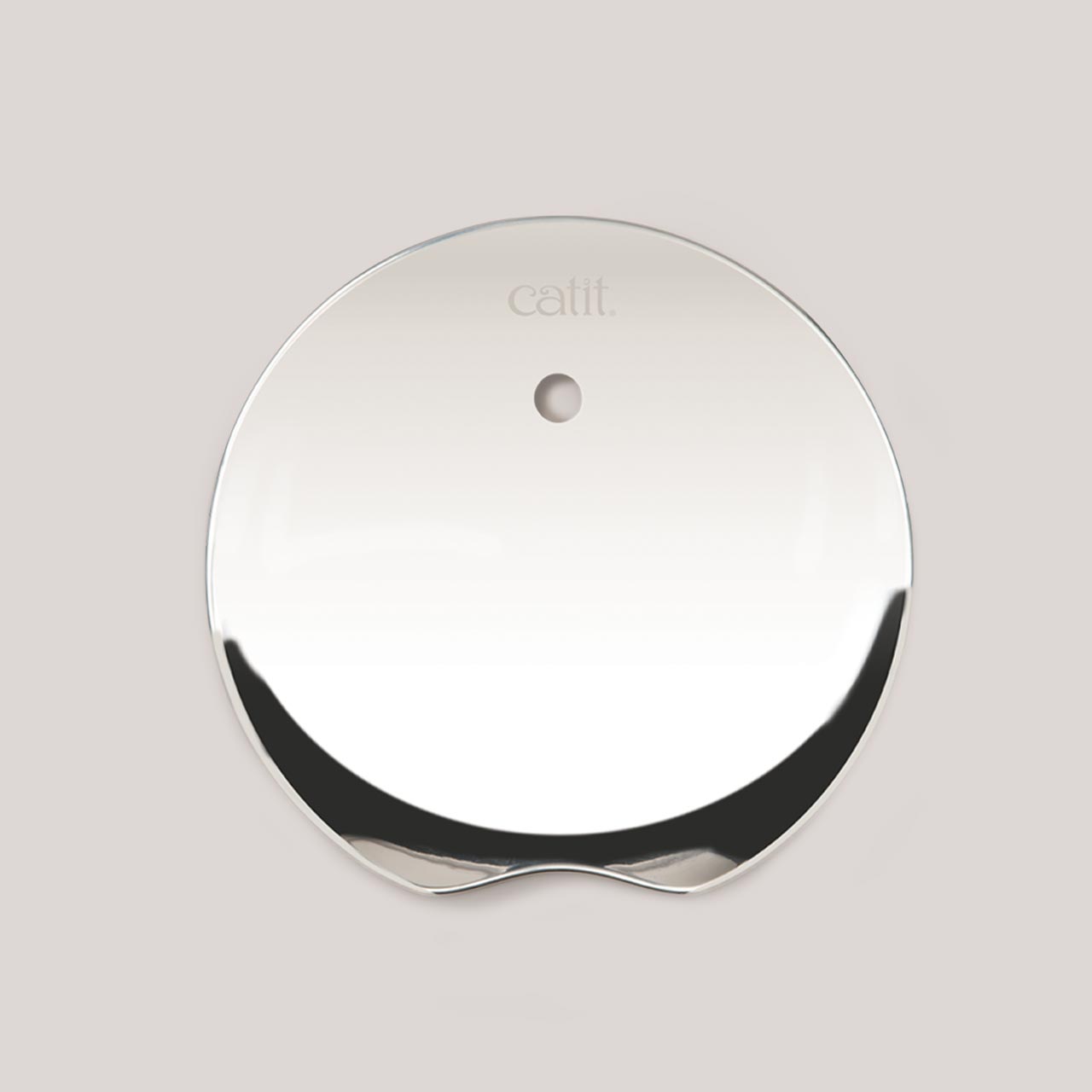 Stainless steel can be a sensible starting point when you want a product with clearly documented washable parts, but the wording in the listing matters. Catit says the stainless-steel top on its PIXI Drinking Fountain can be cleaned in a dishwasher; that statement applies to the top, not automatically to the fountain’s pump, filter or all other pieces.
Pioneer Pet’s Raindrop Premium Stainless Steel Drinking Fountain is another example of useful ownership documentation. Its official listing describes an 18/8 stainless-steel fountain, says it is easy to clean and dishwasher safe, gives a 60 oz capacity, and names compatible replacement filters and pump. This makes it easier to check ongoing consumables before buying.
Before choosing any stainless-steel model, confirm:
- exactly which parts are dishwasher safe;
- how the top, filter and pump come apart for cleaning;
- the stated capacity and whether it suits your refill routine;
- the current part numbers for filters and pumps; and
- whether replacement components are available where you shop.
A steel drinking surface does not remove the need to inspect the rest of the design. A fountain with accessible, documented components is usually easier to assess than one described only by its surface material.
Plastic: Where Model Design Matters Most
“Plastic fountain” is too broad to predict the ownership experience. PetSafe’s current cat-fountain range, for instance, includes plastic models with different capacities, water-flow approaches and configurations. Those differences can change the refill, cleaning and placement routine more than the category label itself.
Use the product manual and current manufacturer listing to check whether the water-contact pieces can be removed, whether dishwasher instructions are provided, and how the pump cavity is reached. Look for named replacement filters and pumps, then confirm that the relevant parts are still sold for that model.
Capacity is another separate decision. PetSafe groups its listings across capacities from smaller options through 64 oz, 128 oz and larger ranges. A larger reservoir may fit a less frequent refill routine, but it does not tell you how straightforward the pump or filter will be to service.
Before buying, save the manual and note the model number. That gives you a concrete reference for cleaning directions and replacement parts after the purchase, rather than depending on a generic description of plastic.
Ceramic: Handling and Cleaning Questions to Ask
Ceramic fountains should also be judged from the exact product documentation. PetSafe lists its Creekside Ceramic Pet Fountain with a 60 oz capacity and dishwasher-safe ceramic, while its broader range shows that capacity, filtering and pump arrangement are separate product choices.
First, check the manufacturer’s cleaning directions and identify which components they cover. A dishwasher-safe ceramic body does not by itself confirm dishwasher compatibility for a pump, filter, cable or every removable fitting. Next, look at the product’s footprint and decide where it can sit securely, away from an edge or a busy route through the room.
Handling deserves the same attention. Consider who will lift the fountain to refill or clean it, how far it must travel to the sink, and where you will set removable parts while washing them. If moving it frequently would be inconvenient in your home, compare the routine against alternatives before committing.
Finally, confirm replacement-filter and replacement-pump support for the exact model. Surface material does not answer whether those consumables are available, compatible or easy to change.
Choose by Your Routine, Not a Single Material Rule
AI-generated generic editorial illustration — not a retailer product photo and does not depict the reviewed product or service. Turn the material comparison into a routine-led selection checklist without implying a universal material winner.
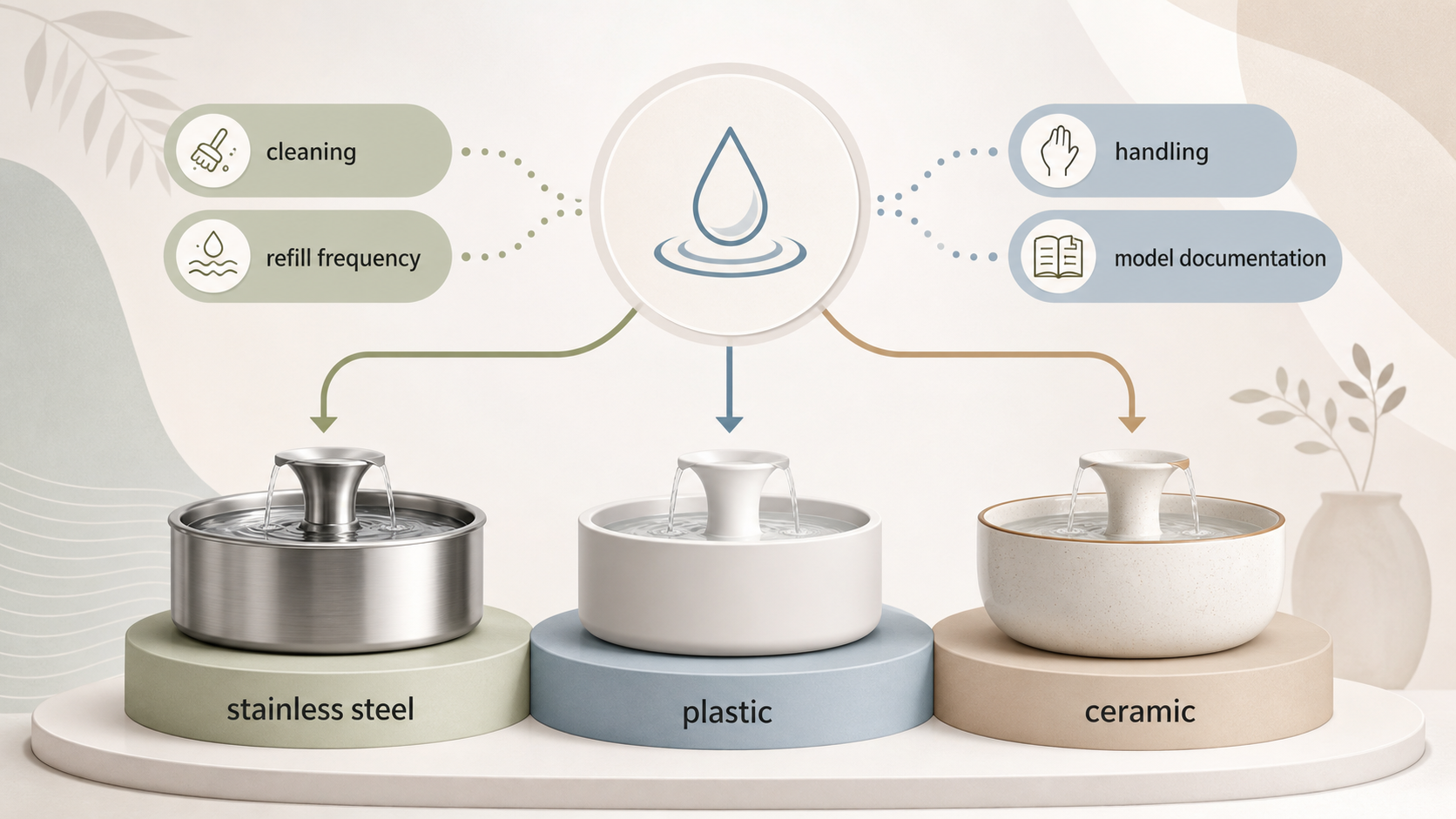 Use a routine-led choice path:
- Start with cleaning. If dishwasher use matters to you, identify the precise parts the maker says are dishwasher safe. Catit’s PIXI listing specifically covers its stainless-steel top, while PetSafe’s Creekside listing specifically describes dishwasher-safe ceramic. Treat each statement as component-specific unless the manufacturer says otherwise.
- Match capacity to refilling. Compare the stated reservoir size with your household’s preferred refill frequency. Pioneer Pet lists 60 oz for its Raindrop model, and PetSafe’s range includes multiple capacity bands. Capacity is a model feature, not a material property.
- Inspect component access. Find out how the filter and pump are removed, cleaned and reinstalled. A surface that looks suitable on paper can still be paired with a design that does not suit your maintenance routine.
- Plan for handling and placement. Think about the route from the fountain’s usual location to the sink, the available counter space for cleaning and whether the household setup makes regular moving inconvenient.
- Check the ownership trail. Look for a current manual, filter identifiers, pump identifiers and a route to buy replacements. Pioneer Pet’s listing is a useful example because it names its replacement filters and pump; check whether any prospective model offers equally clear support.
This approach avoids a universal ranking. Stainless steel, plastic and ceramic can each appear in fountains with very different capacities, cleaning instructions and component layouts. The better fit is the model whose documented care steps and replacement-part support you can realistically maintain.
Frequently Asked Questions
Are all stainless-steel cat fountain parts dishwasher safe?
No. Check the exact wording in the manufacturer’s listing or manual. Catit says the stainless-steel top on its PIXI fountain is dishwasher safe; that does not establish dishwasher safety for the pump, filter or every other part. Pioneer Pet describes its Raindrop fountain as dishwasher safe, but you should still follow the current instructions for its removable components.
How can I tell whether a fountain’s pump and filter will be easy to replace?
Look for a current manual and specific replacement part information. Pioneer Pet identifies replacement filter and pump part numbers for its Raindrop model. For any other fountain, confirm that the listing or support material identifies compatible consumables and explains how the parts are accessed.
Does fountain capacity matter more than surface material for daily refilling?
Capacity directly affects the amount of water the reservoir holds, so it is an important refill-routine consideration. PetSafe lists cat fountains across several capacity ranges, and Pioneer Pet lists 60 oz for its Raindrop model. Compare capacity alongside cleaning and component access rather than treating it as a material characteristic.
What should I check before moving or placing a ceramic fountain?
Read the model’s cleaning instructions, assess the fountain’s footprint and choose a stable location that works for your usual cleaning route. Also confirm what must be removed before washing and whether filters and pumps remain available. These checks are more useful than assuming that every ceramic fountain has the same handling needs.
Sources
Related reading
- Best cat water fountains: an evidence-led comparison of cleaning, capacity, materials and filter upkeep
- Catit water fountain review: strengths, limits, cleaning and replacement-filter trade-offs
- Pioneer Pet Raindrop review: stainless steel design, cleaning, filters and practical limits
- How to choose a cat water fountain for your home, routine and cleaning tolerance
Editorial information: About our editorial team · Read our editorial policy · Read our affiliate disclosure.