A good cat water fountain is not necessarily the largest, quietest-looking or most feature-packed option. It is the one that suits the way your household actually works: how often you are happy to refill it, where it can sit safely, how easily you can clean it, and whether you can obtain the filters or parts it needs.
Start With Your Household, Not a Product Ranking
AI-generated generic editorial illustration — not a retailer product photo and does not depict the reviewed product or service. Give readers a quick visual framework before they compare fountain styles.
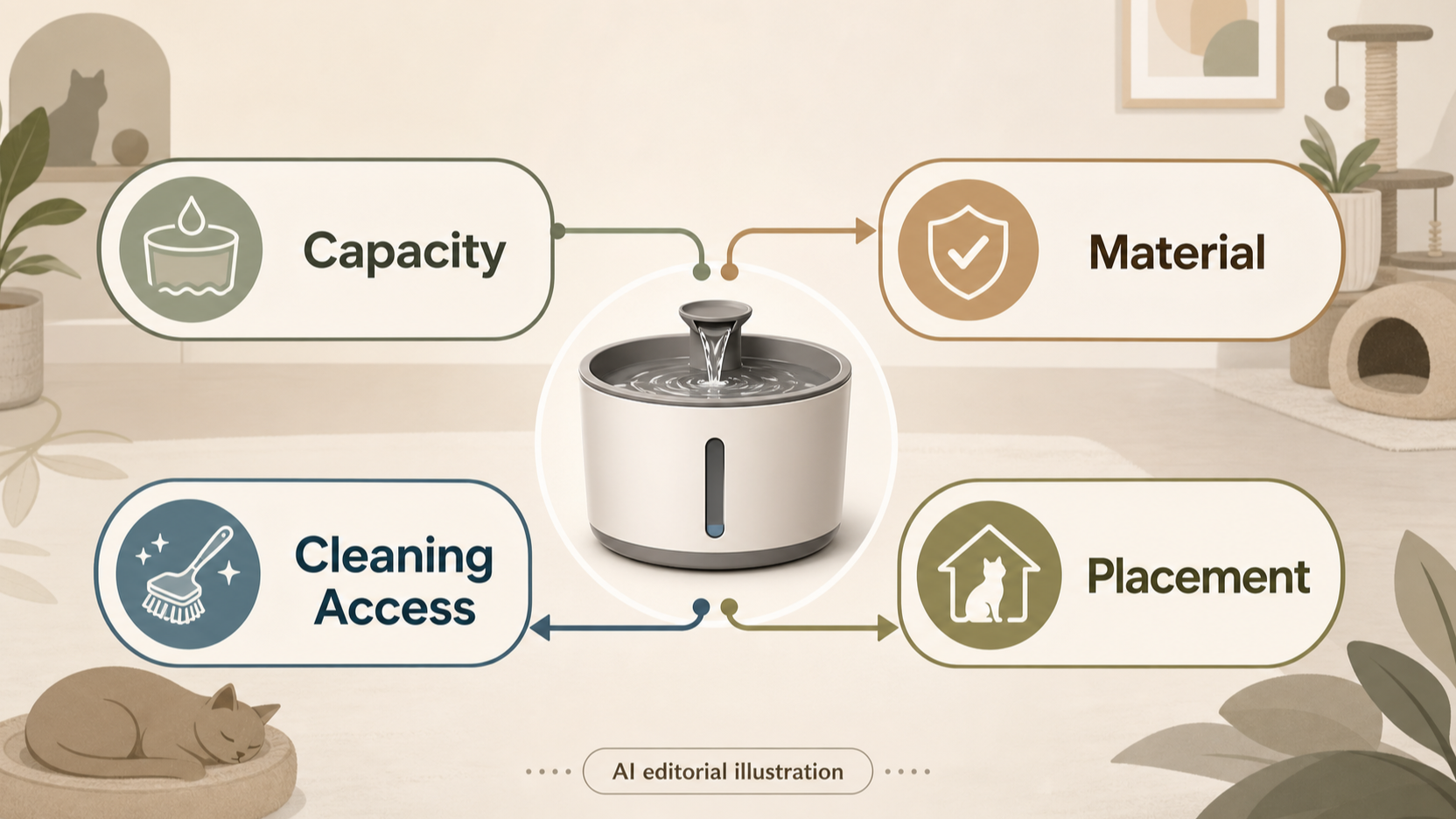 Start with your routine rather than a product list. A fountain is an ongoing household item, so capacity, surface material, water-flow design, cleaning access, filter supply and placement all need to work together. A model that looks ideal on a product page can still be a poor fit if its reservoir is awkward for your refill schedule or its pump is difficult to reach when it is time to clean.
Use four practical filters before comparing individual fountains:
- Capacity: How often are you realistically willing to refill it?
- Material: Which surface are you comfortable lifting, washing and living with?
- Maintenance: Can you remove and clean the parts you will need to handle?
- Placement: Is there a stable, accessible spot with the required power arrangement?
Official PetSafe listings show that indoor fountains are available in several capacities, materials and flow styles, including plastic, stainless steel and ceramic options. That range is useful because it shows there is no single specification that suits every home. Instead, write down your non-negotiables first: a refill interval you can keep up with, a suitable location, and a maintenance routine you can repeat.
If you are also adjusting your cat’s wider daily setup, pair this decision with a hydration-routine guide and a feeding-station placement guide. The aim is not to predict what every cat will prefer; it is to choose a fountain you can set up and maintain consistently.
Match Reservoir Capacity to Your Refill Routine
Capacity changes the rhythm of ownership. A larger reservoir can reduce how often you need to top up water, while a smaller one may be easier to carry, empty and clean. The useful question is therefore not “What is the best capacity?” but “What refill pattern fits this household?”
PetSafe’s current fountain range includes examples from 50 oz and 60 oz through 70 oz, 90 oz, 128 oz, 140 oz and 168 oz, with filters that also group products as small, medium and large. Treat those figures as examples of the variety on the market, rather than as a universal recommendation for a particular number of cats.
For one cat, consider whether a compact reservoir would make routine cleaning easier or whether a larger reservoir would make your week simpler. In a multi-cat home, capacity may deserve more weight because the fountain can need attention more often. PetSafe describes its 128 oz Drinkwell Stainless Multi-Pet Fountain as designed for multiple-pet households, but the right choice still depends on your refill habits, space and the rest of your water setup.
A practical shortlist rule is to choose the smallest capacity that you can refill comfortably without making cleaning inconvenient. Then check the product instructions for its actual usable capacity, recommended care steps and any limitations on where it can be used. A daily pet-care routine guide can help you match that decision to the tasks you already do.
Choose a Surface Material You Will Maintain
AI-generated generic editorial illustration — not a retailer product photo and does not depict the reviewed product or service. Help readers compare practical options without depicting a product.
 Material affects everyday handling as much as appearance. PetSafe’s fountain listings include BPA-free plastic, plastic, stainless steel and ceramic products, while Catit’s fountain range includes stainless-steel and ceramic models alongside other fountain designs. These are categories to compare, not proof that one material is automatically right for every cat or home.
Stainless steel may suit a household that wants a metal surface and a comparatively robust-looking unit. Ceramic can appeal if you prefer its finish and weight; PetSafe lists a ceramic fountain as scratch-resistant and dishwasher safe. Plastic and BPA-free plastic options can offer a different balance of weight, form and price, but they still need close inspection for removable parts, seams and the cleaning method set out by the manufacturer.
Think about the route from shelf to sink. Will you carry the fountain through a busy kitchen? Does it need enough weight or grip for its chosen floor? Could a heavier or more breakable unit be awkward in your space? PetSafe’s Platinum fountain is described as designed to resist sliding and tipping, which illustrates why base stability belongs in the material and placement conversation.
Do not choose by material name alone. Read the product-care instructions, consider how the item will be handled in your home, and select the surface you are most likely to clean properly. A pet-bowl cleaning checklist is a useful companion when comparing the work each design creates.
Consider Drinking Style, Flow and Noise-Relevant Design
Fountains vary in how water is presented. PetSafe lists soft-bubbling models, adjustable-flow options, multiple stream options and fountains with more than one bowl level. It also describes a stainless multi-pet model with customisable water streams and a Pagoda fountain with two bowl levels. Those features give you practical categories to observe, rather than a guarantee that a particular cat will accept a particular design.
Start with what you have already seen at home. Does your cat approach a still bowl readily, show curiosity around moving water, or prefer a lower and more open drinking area? An independent Cats.com review notes that some cats show a preference for running water, but individual behaviour can differ. Use that as a reason to observe your own cat carefully, not as a reason to assume a fountain will solve a drinking concern.
Noise-relevant design also matters in a shared home. A listing may describe a pump as quiet or a fountain as soft bubbling, but the useful test is whether the design, location and expected maintenance fit your household’s tolerance for sound. A poorly placed fountain can be distracting even if its product description emphasises quiet operation.
If you are unsure, make this a cautious trial. Keep the existing water option available while your cat gets used to the new accessory, follow the manufacturer’s setup instructions and watch how the fountain fits ordinary routines. A guide to introducing a new cat accessory can help you take that gradual approach.
Check Cleaning Access, Filters and Replacement Parts Before Buying
Maintenance is where many otherwise attractive fountains become impractical. Before buying, look beyond the exterior and identify which parts you will need to remove: the lid or tray, reservoir, pump, filter housing and any cable or battery component. PetSafe’s range includes a wire-free pump marketed for quick, easy cleaning, a pumpless fountain, submersible-pump designs, cordless products and models described as dishwasher safe. These are useful features to compare against the cleaning method you can genuinely sustain.
Check the manual or current manufacturer listing for the care routine rather than relying on a generic schedule. Cleaning needs can vary by model, water conditions, household use and the maker’s instructions. Put the required tasks into your normal routine: emptying, rinsing, washing removable components, checking the pump area and replacing filters where required.
Filters are an ownership commitment, not merely an accessory. PetSafe’s fountain category includes filters and accessories, and some product listings identify filtration as part of the design. Before ordering a fountain, confirm the exact replacement-filter type, where it is currently sold, whether compatible parts are clearly identified, and what other replaceable components may be available. This is especially important if you are considering a less common design or a model that uses a particular pump arrangement.
Avoid assuming that a cordless fountain eliminates maintenance. A rechargeable battery may broaden placement choices, but it introduces another component to check and recharge. A replacement-filter buying guide and pet-product maintenance schedule can turn these checks into a repeatable household task.
Plan Power, Placement and Multi-Pet Use
Choose the location before you choose the final model. Measure the available floor or counter space, then think through access to water, the nearest outlet if the model uses one, cord routing, refill clearance and how easily you can lift the unit away for cleaning. PetSafe lists both corded and cordless fountains, including a cordless model with a rechargeable battery, so power source can be a meaningful filter rather than an afterthought.
A stable surface matters. Consider household traffic, playful pets, children, nearby food areas and how much splash or spill risk the location can tolerate. Some fountains are built with features such as a deep drinking bowl to reduce spills or a base intended to resist sliding and tipping, but placement still needs to suit the room. Do not rely on a product feature to compensate for an unstable or inconvenient site.
For multiple pets, consider access as well as reservoir volume. A larger capacity may be helpful, but bowl layout, available floor space and the way your animals share resources can matter too. PetSafe’s listings include a multi-pet fountain and a two-level-bowl design, illustrating that the drinking area itself can vary.
Make a simple placement check: can you reach the fountain to refill it, can you clean around it, can you route power safely if needed, and will the site remain usable when the household is busy? Use a home pet-safety checklist and a multi-cat household setup guide to review the wider environment.
Use a Shortlist Method Before You Buy
Turn the comparison into a short, repeatable process.
- Set your non-negotiables. Record the location, power arrangement, capacity range and surface material you can live with.
- Compare maintenance access. Eliminate models whose pump, reservoir or filter arrangement you would struggle to clean.
- Confirm ongoing supply. Check the current manufacturer documentation for replacement filters, pump parts and care instructions.
- Compare drinking presentation. Note whether the design offers a stream, soft bubbling, bowl levels or another format that seems compatible with your cat’s observed habits.
- Review the whole setup. Include stability, traffic, refill access and the practical consequences of cords or rechargeable components.
This method keeps the decision grounded in ownership rather than marketing language. A 60 oz fountain may be appropriate for one routine and insufficiently convenient for another; a ceramic model may be ideal for one home and unsuitable for a location where breakage is a concern. Product specifications help you narrow the field, but they do not replace your household constraints.
Before purchase, re-check the current product page and manufacturer documentation. Model specifications, included accessories and replacement-part availability can change. Use a printable pet-product comparison checklist to keep your shortlist focused on the features you will still care about after the first week.
Frequently Asked Questions
How often should I expect to clean a cat water fountain?
Follow the instructions supplied for the specific fountain and build its stated care tasks into your routine. Cleaning access differs between designs: current PetSafe listings include dishwasher-safe ceramic, wire-free-pump, cordless, pumpless and submersible-pump options. The practical choice is the one whose removable parts and cleaning steps you can manage consistently.
Should I choose a larger fountain for more than one cat?
A larger reservoir can reduce refill frequency, and PetSafe lists a 128 oz stainless model designed for multiple-pet households. However, capacity is only one consideration. Also assess the drinking area, placement, how pets share the space and whether you can comfortably clean the larger unit. There is no universal capacity minimum based solely on cat number.
What should I check about replacement filters before buying?
Identify the exact filter type named in the manufacturer documentation, then confirm that it is currently available from a reliable source. Also check whether the fountain has other replaceable parts, how those parts are accessed and whether the cleaning instructions explain their care. Treat this as part of the total ownership decision, not a detail to discover later.
Is a cordless fountain always the better placement option?
No. A cordless, rechargeable model can make some locations easier to consider, but it still needs a stable, accessible position and a battery-charging routine. A corded model may be perfectly suitable where an outlet and safe cable route are already available. Choose the power arrangement that makes daily refilling and regular cleaning easiest in your home.
Next step: Use a household comparison checklist to score your finalists for capacity, cleaning access, filter availability and placement before you buy.
Sources
Related reading
- Best cat water fountains: an evidence-led comparison of cleaning, capacity, materials and filter upkeep
- Catit vs PETLIBRO cat water fountains: flow, cleaning, filters and smart features compared
- PETLIBRO Dockstream review: smart tracking, cordless design, cleaning and ongoing costs
- Stainless steel vs plastic vs ceramic cat water fountains: cleaning, weight and daily-use trade-offs
Editorial information: About our editorial team · Read our editorial policy · Read our affiliate disclosure.