A low headline price can be tempting, but it does not tell you whether a cat water fountain is the right purchase for your home. A better deal is a documented offer you can compare: the same model, the same capacity and material, the same included components, and realistic access to the items needed to keep it running.
This guide is for indoor cat water fountains and focuses on product information, buying terms and likely ownership costs. It does not make veterinary claims or assume that one fountain design is suitable for every cat or household.
What Counts as a Genuine Cat Water Fountain Deal
A genuine deal is not simply the cheapest listing. It is the offer that gives you the clearest, comparable package for your needs after you account for what is included and what you may need later. A lower initial price can be less useful if the listing leaves the model unclear, omits the filter type, or makes it difficult to identify compatible replacements.
Start by treating the promotion as a package rather than a price tag. Ask: which exact fountain is being sold, what comes in the box, and what ongoing items does that model use? Official catalogues illustrate why this matters: cat fountains are sold in different capacities, materials and water-flow formats, rather than as one interchangeable product category. PetSafe’s cat fountain catalogue lists stainless-steel, BPA-free plastic and plastic options, alongside multiple capacities and flow descriptions.
The best offer is therefore the one you can document and compare on like-for-like terms. A promotion with a clearly named model, a stated included filter pack and transparent delivery and return conditions may be easier to assess than a cheaper listing with missing details. If the information cannot be confirmed, treat the apparent saving as uncertain rather than assuming the missing parts are included.
For broader context, see our cat water fountain buying guide and cat feeding and hydration products guide.
Start With the Exact Model and Included Package
Before comparing prices, write down the exact model name or product ID from each offer. Then record the listed capacity, material, power arrangement, water-flow description and every included component. This prevents a common comparison error: placing a base fountain beside a bundle that includes filters, replacement parts or another accessory, then treating the difference as a straightforward discount.
Official product ranges show how much can vary under the same general label. PetSafe’s catalogue includes fountains from 50 oz through larger listed capacities, with options described as stainless steel, ceramic or plastic and with features such as adjustable flow, multiple streams or gravity-fed operation. PetSafe also lists models with different stated capacities, including 60 oz, 128 oz, 168 oz and 256 oz. Those descriptions are useful identifiers; they are not proof that two differently named products share the same parts.
Use a simple comparison line for every offer:
- Exact brand, model and product ID
- Stated capacity and material
- Included filter, pump, adaptor or other components
- Seller, price, delivery charge and return terms
- The official page or manual that identifies the replacement parts
If a retailer uses only a generic title such as “cat fountain”, look for a manufacturer model number, package photograph or specification sheet before comparing it with another listing. Do not fill in missing details from a similar-looking product. Similar capacity or colour does not establish that filters, pumps or fittings are compatible.
Our how to compare pet product offers guide and cat fountain capacity guide can help you keep the comparison consistent.
Compare the Features That Affect Everyday Use
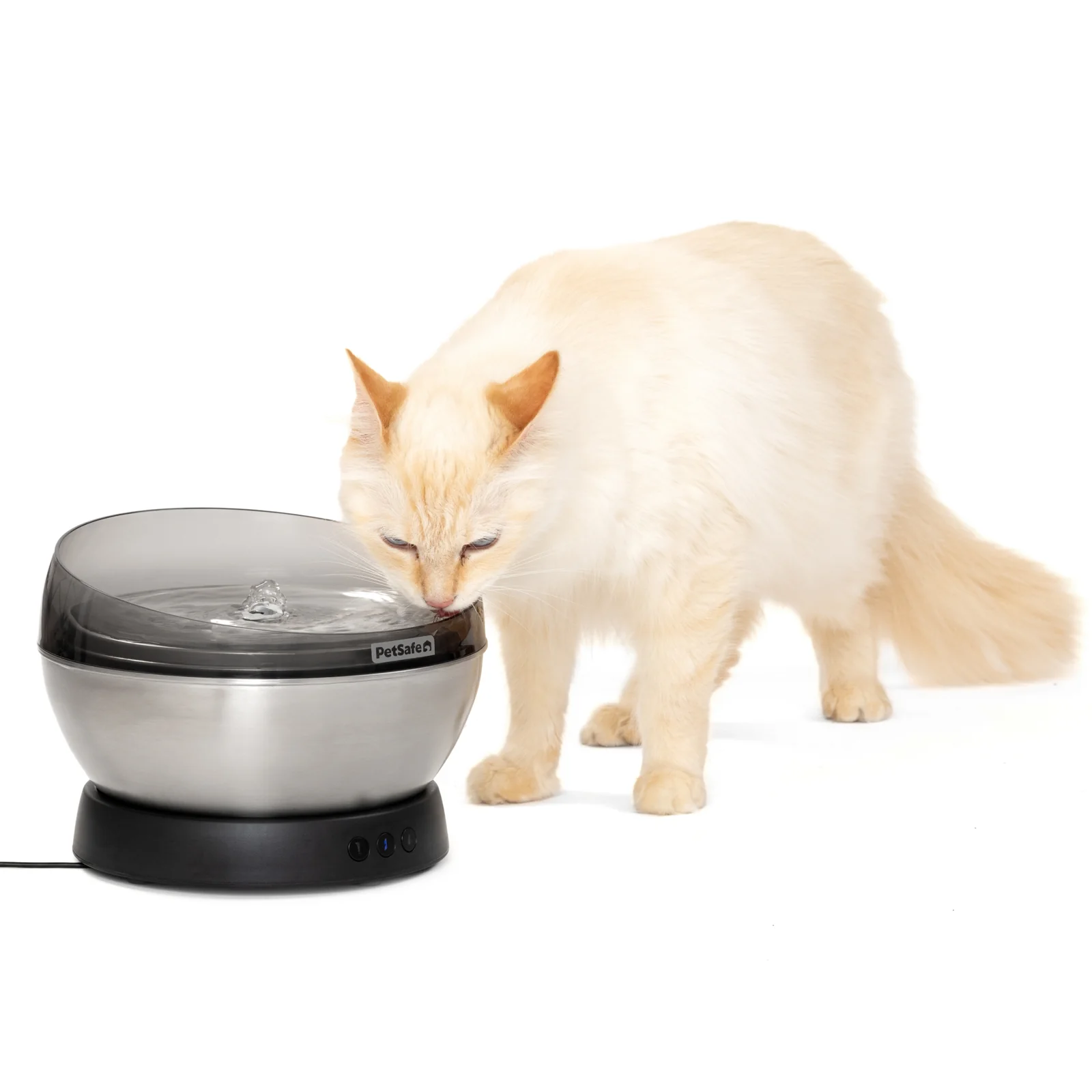 A deal only has value in the context of your household. Capacity, material and fountain design are practical attributes to compare, but none should be treated as an automatic winner. Instead, use the manufacturer’s stated description to decide whether an offer matches the features you actually need to maintain and accommodate.
Capacity is one useful starting point. PetSafe categorises its cat-fountain range by listed capacities, including small options up to 64 oz, medium options from 65 oz to 128 oz, and large options from 129 oz to 256 oz. Its catalogue also shows that some individual fountains are offered in more than one capacity. Compare the stated capacity with your refill routine and household size, but do not assume a larger reservoir is always better value; it may be a different model with different components and cleaning considerations.
Material and layout should be recorded in the same way. PetSafe lists stainless steel, BPA-free plastic and plastic fountains, as well as products described with adjustable, non-adjustable, bubbling, gravity-powered or multiple-stream water flow. These are product characteristics to weigh against your preferences and cleaning routine, not a basis for making unsupported material or performance rankings.
When an offer looks attractive, ask whether the discounted version has the same material and stated capacity as the version you were considering. A similar product name can conceal a different configuration. Keep the manufacturer’s specification open while you compare retailer copy.
For more household-specific considerations, visit our multi-cat fountain guide and stainless-steel versus ceramic cat fountains guide.
Check Filter and Replacement-Part Support
Replacement support can materially affect long-term value, so verify it before buying rather than after a promotion ends. The key question is not whether a brand sells some filters or pumps. It is whether the official listing identifies a replacement as compatible with the exact fountain model or product family you plan to buy.
Pioneer Pet’s official fountain catalogue provides a concrete example of why this distinction matters. It lists separate replacement filters for ceramic and stainless-steel fountains and for plastic fountains, as well as a round filter described for Vortex and Elevated Vortex models only. Pioneer Pet’s catalogue also lists replacement items such as pump housings, pumps and transformers, gaskets and suction cups. These are category- and model-specific descriptions, not evidence that every item works with every Pioneer Pet fountain.
Make a compatibility record before checkout:
- Find the fountain’s exact product name or ID.
- Locate the official filter, pump or fitting listing that names that fountain, material group or model family.
- Check whether the item is currently listed and whether the seller identifies what is included in the bundle.
- Note the part number, pack size and any “only” or material-specific wording.
Official help resources can make the process easier. Catit’s Flower Fountain support page links users to filters, maintenance information, product registration, customer service and the latest instruction manual. Catit support is an example of the type of model-level support page worth finding for the fountain you are evaluating.
A discounted fountain with documented compatible consumables may be easier to plan for than a cheaper one whose replacement route is unclear. See our cat fountain filter buying guide and pet product replacement parts guide for a reusable check.
Account for Cleaning, Maintenance and Noise-Relevant Design
A fountain’s ownership effort is shaped by its documented design and the maintenance information available for it. Before treating a saving as decisive, look for the cleaning instructions, access to the pump and filters, stated dishwasher-safe components, and the power arrangement. These details can affect how easily you can follow the manufacturer’s maintenance guidance.
Do not infer maintenance requirements from appearance alone. For example, PetSafe describes particular models with features such as a wire-free pump, a submersible pump, dishwasher-safe ceramic, cordless operation or adjustable water flow. Its official listings show that these features vary by model. The right comparison is therefore model-specific: confirm that the feature mentioned in a promotion belongs to the exact item in the basket.
Noise is another area where careful wording helps. A product page may describe a pump or operation as quiet, but that is a design description, not a universal noise rating for every home. Avoid assuming that a similar-looking fountain will perform the same way. Check the official manual or support page for setup and maintenance instructions, and use the seller’s return terms to understand your options if the documented product does not suit your circumstances.
Catit’s support material explicitly separates getting-started information, maintenance guidance, filters and instruction manuals. The Flower Fountain support page shows the kind of documentation that can reduce uncertainty before purchase.
For practical upkeep questions, read our how to clean a cat water fountain guide and cat fountain troubleshooting guide.
Calculate Total Ownership Cost Before You Buy
Once the exact package and compatible parts are identified, calculate total ownership cost instead of relying on the promotional headline. You do not need to predict a single “true” cost. Use a transparent scenario based on the prices and terms you can document at the time of purchase.
A basic calculation is:
Total ownership cost = initial item price + planned consumables + expected replacement parts + delivery charges + any return-related cost you would bear under the stated terms.
For example, compare two offers over the same period you choose for your household. For each offer, enter the listed fountain price. Add the price of the officially compatible filter packs you expect to buy during that period, using the pack size stated on the official or seller page. Then add any compatible pump or fitting cost only if you are deliberately planning for it; do not invent a replacement frequency. Finally, include delivery costs and read the return terms before concluding that one headline price is cheaper.
The compatibility check is the foundation of the calculation. Pioneer Pet’s catalogue differentiates filters for ceramic and stainless-steel fountains from filters for plastic fountains, and lists other replacement components separately. Pioneer Pet therefore illustrates why a generic “replacement filter” line item is not enough for a fair comparison. Catit’s model support page similarly directs owners to the filters needed for that product and to its manual. Catit provides the kind of source to use when identifying a model’s support path.
Keep the result conditional: “Offer A costs less in this scenario if these are the documented compatible filters and these delivery terms apply.” That is more useful and more honest than claiming a guaranteed saving from incomplete information.
Use our pet budget planning guide and subscription and consumables cost guide to adapt the worksheet to your own timeframe.
Use a Pre-Checkout Deal Verification Checklist
Before you buy, pause for a final like-for-like check. The goal is to confirm what the promotion actually covers, not to chase every possible feature.
- Confirm the seller and the exact brand, model and product ID.
- Match the stated capacity, material and design description to the official listing.
- List what is included: fountain, filter, pump, power component and any bundle extras.
- Find official documentation for filters and replacement parts that identifies the relevant model, material group or model family.
- Check the current seller page for price, delivery, stock status and return conditions.
- Read the manufacturer’s setup, maintenance and manual resources where available.
- Save the product and terms pages if you need to compare offers later.
Manufacturer catalogues are valuable for checking the product identity, but they do not replace the seller’s current purchase terms. PetSafe’s catalogue shows that its range contains multiple capacities, materials and flow designs, while Pioneer Pet’s catalogue distinguishes several replacement filters and components. PetSafe and Pioneer Pet can help you identify what to verify; availability, price and terms should still be confirmed on the relevant page at checkout.
If a promotion fails this checklist because it does not identify the model or package, it may still be an offer—but it is not yet a comparable deal. See our online pet shopping safety guide and pet product returns guide before placing the order.
{{primary_cta}}
Frequently Asked Questions
Should I choose the lowest-priced cat fountain or the bundle with filters included?
Choose only after matching the exact model and package. A bundle can be easier to value if the included filters are documented as compatible with that fountain and the total price, delivery charge and return terms are clear. A lower-priced base unit may still cost less in your own scenario, but only after you add the consumables you expect to buy. Pioneer Pet’s separate listings for filters by fountain material group show why a generic filter inclusion claim is not enough. Pioneer Pet
How can I tell whether replacement filters and pumps are compatible with my fountain?
Use the fountain’s exact product name or ID, then look for an official replacement listing that names the model, material group or explicitly stated product family. Record part numbers and any limiting language. Pioneer Pet lists filters for ceramic and stainless-steel fountains separately from filters for plastic fountains, and lists some components with model-specific wording. Pioneer Pet For a supported Catit model, its help page directs users to filters and the instruction manual. Catit
Does a larger-capacity cat fountain always offer better value?
No. Capacity is a stated product attribute, not a complete value verdict. PetSafe’s catalogue includes fountains across several capacity ranges and with different materials and water-flow designs. PetSafe Compare capacity with the exact model, included package, support documentation and ownership-cost scenario that fit your household.
What should I do if a promotion does not identify the exact fountain model?
Ask the seller for the manufacturer model name or product ID, then compare that information with the official product and replacement-part pages. If it cannot be confirmed, do not assume that photographs, capacity claims or included filters match another listing. Treat the offer as incomplete for comparison purposes and check its return terms before deciding whether the uncertainty is acceptable.
For further help, see our cat water fountain buying guide and pet product warranty and returns guide.
Related reading
- PetSafe cat water fountain review: range, capacity, materials and maintenance trade-offs
- How to choose a cat water fountain for your home, routine and cleaning tolerance
- Stainless steel vs plastic vs ceramic cat water fountains: cleaning, weight and daily-use trade-offs
- When to buy a cat water fountain: comparing sale price with filters, pumps and upkeep
Editorial information: About our editorial team · Read our editorial policy · Read our affiliate disclosure.